$55 Million Clayton Redevelopment Turns Former 7UP Headquarters Into 118 Apartments
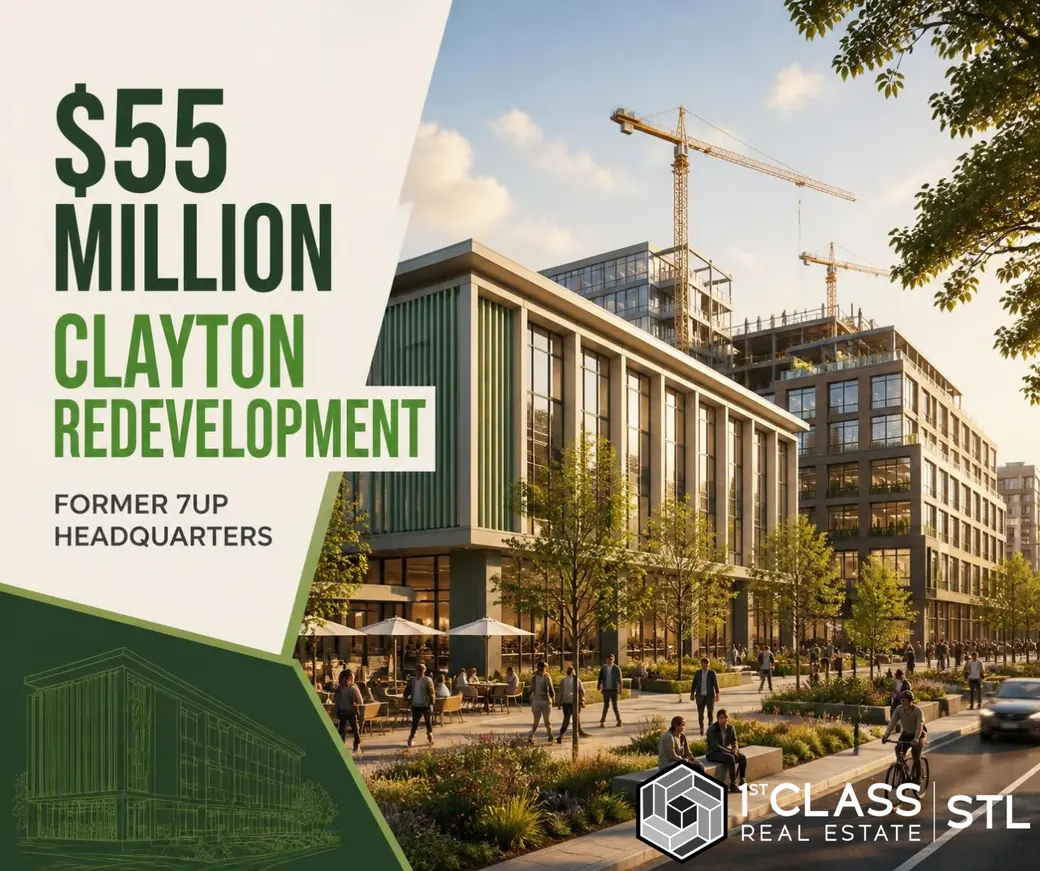
$55 Million Clayton Redevelopment Turns Former 7UP Headquarters Into 118 Apartments
A familiar piece of Clayton real estate is getting a major new life.
The former 7UP headquarters at 121 S. Meramec Avenue in downtown Clayton is being transformed into a new apartment community as part of an approximately $55 million redevelopment project.
The project, known as The Upton, is expected to convert the long-vacant 11-story office building into approximately 118 apartments, including studio, one-bedroom and two-bedroom units.
The redevelopment is another example of a trend we're seeing not only around St. Louis, but across the country:
Taking underused commercial real estate and turning it into much-needed housing.
From Vacant Office Space to 118 Homes
One of the biggest challenges facing commercial real estate over the past several years has been what to do with older office buildings.
Remote and hybrid work changed the amount of office space many companies need, leaving cities across the country with buildings that are partially occupied—or completely vacant.
At the same time, many communities continue to need additional housing.
That's what makes projects like the former 7UP headquarters particularly interesting.
Instead of demolishing the building or allowing it to remain vacant, developers are taking an existing structure in one of the St. Louis area's most desirable locations and giving it an entirely new purpose.
The result will be 118 additional housing units in the heart of Clayton.
Why Clayton Makes Sense for More Residential Development
Clayton is one of the strongest employment and commercial centers in the St. Louis metro area.
But it's also an extremely desirable place to live.
Residents have access to restaurants, businesses, entertainment and major employers while remaining centrally located within the St. Louis region.
That combination creates demand for housing within walking distance of everything downtown Clayton has to offer.
Adding more residential units can also benefit the surrounding businesses.
More residents means more people eating at local restaurants, shopping at nearby businesses and spending money within the community—not just during traditional business hours, but evenings and weekends as well.
Could We See More Office-to-Housing Conversions in St. Louis?
That's the bigger question.
St. Louis has a tremendous amount of existing commercial real estate.
Some of those buildings were constructed for a completely different economy and a completely different way of working.
Meanwhile, housing affordability and inventory remain major concerns for buyers.
That creates an interesting opportunity.
Instead of assuming every new housing unit needs to come from new construction on undeveloped land, some of our future housing supply could come from repurposing buildings we already have.
That doesn't mean converting an office building into apartments is easy.
Developers have to consider plumbing, electrical systems, windows, elevators, parking, zoning, building codes and whether the physical layout of the building actually works for residential units.
Some office buildings simply don't make financial sense to convert.
But when the location, building and economics line up, adaptive reuse can be a powerful redevelopment tool.
This Is Bigger Than One Building
The $55 million investment in the former 7UP headquarters is important on its own.
But it's also part of a much larger conversation happening throughout the St. Louis metro.
What do we do with older commercial properties that no longer serve the purpose they were originally built for?
In many cases, the answer may be housing.
We've already seen developers throughout the region look at former offices, warehouses, schools and other commercial buildings as opportunities for apartments, condos and mixed-use developments.
Rather than allowing these properties to sit vacant for years, redevelopment can put them back into productive use.
What Does This Mean for St. Louis Real Estate?
Projects like The Upton are another reminder that the St. Louis real estate market isn't standing still.
Neighborhoods change.
Commercial districts evolve.
Housing demand shifts.
And properties that once seemed obsolete can suddenly become valuable redevelopment opportunities.
For real estate investors and developers, that means some of the biggest opportunities over the next decade may not necessarily be vacant land.
They could be existing properties being used for the wrong purpose.
For homeowners and buyers, redevelopment can also change the desirability and value of surrounding neighborhoods.
New residents bring additional economic activity. Businesses follow population growth. Infrastructure improves. Previously vacant properties become productive again.
That's why major developments are worth watching even if you're not planning to live in the building itself.
Another Major Investment in the St. Louis Region
It's easy to focus on mortgage rates, home prices and monthly housing statistics when talking about the real estate market.
But development activity tells another important part of the story.
A roughly $55 million investment to transform a vacant office building into 118 homes represents a significant commitment to Clayton and the broader St. Louis region.
And as older commercial properties throughout the metro continue to face changing demand, we may see many more projects like this.
At 1st Class Real Estate STL, we'll continue following major developments, housing trends and changes throughout the St. Louis metro area—and explaining what they could mean for local homeowners, buyers, sellers and investors.
Thinking about buying, selling or investing in the St. Louis area?
Our local real estate professionals can help you understand what's happening in your specific neighborhood and how today's changing market could affect your next move.
1st Class Real Estate STL
Increasing The Success Rate Of The Real Estate Agent
Categories
Recent Posts