Can You Really Buy a House at a St. Louis Tax Sale? Here’s How It Works

Can You Really Buy a House at a St. Louis Tax Sale? Here’s How It Works
You may have heard stories about investors buying houses for only a few thousand dollars because the previous owner didn't pay their property taxes.
But can you actually do that in St. Louis?
Yes—but it's not nearly as simple as buying a $150,000 house for a $5,000 tax bill.
St. Louis already has a process for selling properties with delinquent real estate taxes, and the topic has received renewed attention as the City moves to address hundreds of vacant and neglected properties.
In fact, St. Louis' final scheduled land-tax sale of 2026 began this week.
So let's look at how these sales work, how they differ from LRA properties, and why investors should pay attention.
What Is a St. Louis Land Tax Sale?
When property owners fail to pay their real estate taxes, the property can eventually become subject to foreclosure and sale.
In the City of St. Louis, delinquent properties can be offered through Sheriff's land-tax sales.
These aren't traditional real estate transactions.
You're not simply touring a house, making an offer to the owner, completing inspections and closing with a mortgage like you would when purchasing a normal home.
Instead, you're purchasing a property through a legal process designed to address delinquent real estate taxes.
That's an important distinction.
Does Bidding Really Start at the Amount of Taxes Owed?
Potentially, yes.
The opening amount on a tax-sale property can be tied to the delinquent taxes and other costs associated with the property rather than its traditional market value.
That creates headlines and stories about properties being purchased for incredibly low prices.
But there's a huge difference between a property's purchase price and what the property will ultimately cost you.
Imagine purchasing a property for $15,000 that might eventually be worth $150,000.
Sounds incredible.
But what if it needs:
-
$20,000 in foundation repairs
-
$15,000 for a roof
-
$12,000 in electrical work
-
$10,000 in plumbing
-
$25,000 in interior renovations
-
Additional money for permits, cleanup and holding costs
Suddenly, that $15,000 house isn't really a $15,000 house.
That's why investors need to evaluate the entire project—not just the auction price.
What Makes the New 500-Property Initiative Different?
This is one of the biggest questions we've received since discussing the City's recent vacant-property initiative.
Someone asked:
"How is this different from the tax sales or LRA properties that already exist?"
It's a great question.
The biggest difference is that the underlying mechanisms aren't necessarily new.
St. Louis already has tax sales.
St. Louis already has LRA-owned properties.
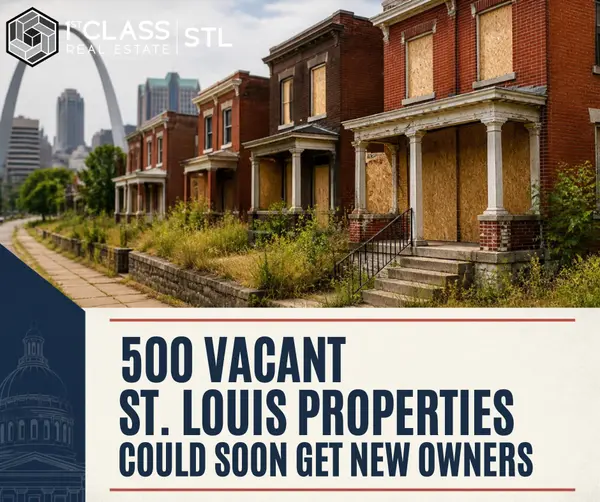
What's noteworthy about the recently announced initiative is the City's effort to proactively move a large group of roughly 500 vacant, neglected and tax-delinquent privately owned properties through the foreclosure and special tax-sale process.
Rather than creating an entirely new way for investors to purchase property, the effort is intended to push more problem properties through existing legal mechanisms and eventually get them back into productive use.
If the approach works, officials have indicated that it could potentially be expanded.
And that's where this gets particularly interesting for St. Louis real estate.
What's the Difference Between a Tax-Sale Property and an LRA Property?
These terms are sometimes used interchangeably in conversations about distressed St. Louis real estate, but they're not the same thing.
A tax-sale property is generally still going through the process associated with delinquent taxes and foreclosure.
An LRA property has already ended up under the control of the Land Reutilization Authority.
The LRA holds thousands of properties acquired through tax foreclosure and other means and makes many of them available for purchase and redevelopment.
In simple terms:
Tax sale: You're potentially purchasing the property as it moves through the delinquent-tax foreclosure process.
LRA: The property has already moved beyond that point and is now publicly owned and being offered for redevelopment or purchase.
That difference can significantly affect how you acquire the property and what you'll need to do afterward.
Why Doesn't Everyone Just Buy Cheap Tax-Sale Properties?
Because there's a reason many of these properties are cheap.
Some may have been vacant for years.
You could be dealing with major structural damage, fire damage, missing plumbing, stolen wiring, foundation problems, water intrusion or roofs that have failed.
Some properties may ultimately make more sense to demolish than renovate.
There can also be title issues and other legal considerations that don't normally exist in a traditional real estate transaction.
That's why these properties should never be viewed simply as:
Market Value – Auction Price = Profit
The real calculation is much more complicated.
An investor needs to understand the acquisition cost, rehabilitation budget, title situation, carrying costs, taxes, insurance, utilities, permits, financing costs and eventual resale value or rental income.
But There Could Be Significant Opportunities
Despite the risks, this is exactly why investors pay attention to tax sales and distressed properties.
St. Louis has something many major metropolitan areas don't:
A tremendous amount of older housing stock at relatively affordable price points.
If investors can acquire properties inexpensively, renovate them responsibly and return them to productive use, there can potentially be opportunities to create equity while improving neighborhoods.
This is especially true for experienced investors who understand construction costs and know how to accurately determine a property's after-repair value.
Could This Help St. Louis' Housing Inventory?
This is perhaps the most interesting part of the conversation.
People frequently say that St. Louis needs more housing.
That's true in many parts of the region.
But the City also has existing houses that aren't currently functioning as usable housing.
They're vacant.
They're deteriorating.
Some have been sitting for years.
So one way to increase housing inventory isn't necessarily to build another subdivision.
It's to turn an existing vacant house back into a livable house.
If hundreds—or eventually thousands—of vacant properties can be transferred to responsible owners and renovated, they can once again become homes.
That could mean rental housing.
It could mean affordable starter homes.
It could mean owner-occupied residences.
Or it could mean redevelopment of properties that are simply too far gone to save.
One Vacant House Can Affect an Entire Block
There's also a neighborhood impact that goes beyond the individual property.
Imagine a block with ten occupied homes and one abandoned house.
The grass grows several feet tall.
Windows get broken.
The roof begins collapsing.
Trash accumulates.
Eventually, neighboring homeowners start wondering what that abandoned property is doing to the value of their own homes.
Now imagine an investor buys it.
The roof gets replaced.
The yard gets cleaned up.
New windows go in.
The exterior gets painted.
A family eventually moves into the house.
The impact extends beyond that one property.
That's ultimately why getting vacant properties back into productive use matters.
Should You Buy a Property at a St. Louis Tax Sale?
Tax-sale properties can potentially offer significant investment opportunities—but they're not something you should purchase simply because the price looks cheap.
Do your homework.
Research the property.
Understand the neighborhood.
Estimate the repairs.
Investigate title issues.
Know the rules of the sale.
Determine your realistic after-repair value.
And build a margin into the project for the unexpected—because with distressed properties, unexpected expenses are common.
A $10,000 property can be an incredible investment.
It can also become an incredibly expensive mistake.
The difference usually comes down to due diligence and understanding the numbers before you buy.
We'll Continue Following the 500-Property Initiative
The City's recently announced effort involving roughly 500 vacant and tax-delinquent properties is still developing.
We'll be watching for additional information about which properties are involved, how and when they may become available, and what opportunities could eventually exist for homeowners and investors.
At 1st Class Real Estate STL, we believe understanding what's happening locally is just as important as following national housing headlines.
If you're considering purchasing an investment property, distressed property or traditional home anywhere throughout the St. Louis metro area, our local real estate professionals can help you evaluate the property, neighborhood and numbers before you make your move.
1st Class Real Estate STL
Increasing The Success Rate Of The Real Estate Agent
Categories
Recent Posts