854 New Homes Planned in Foristell: Is the St. Louis Metro Continuing to Move West?
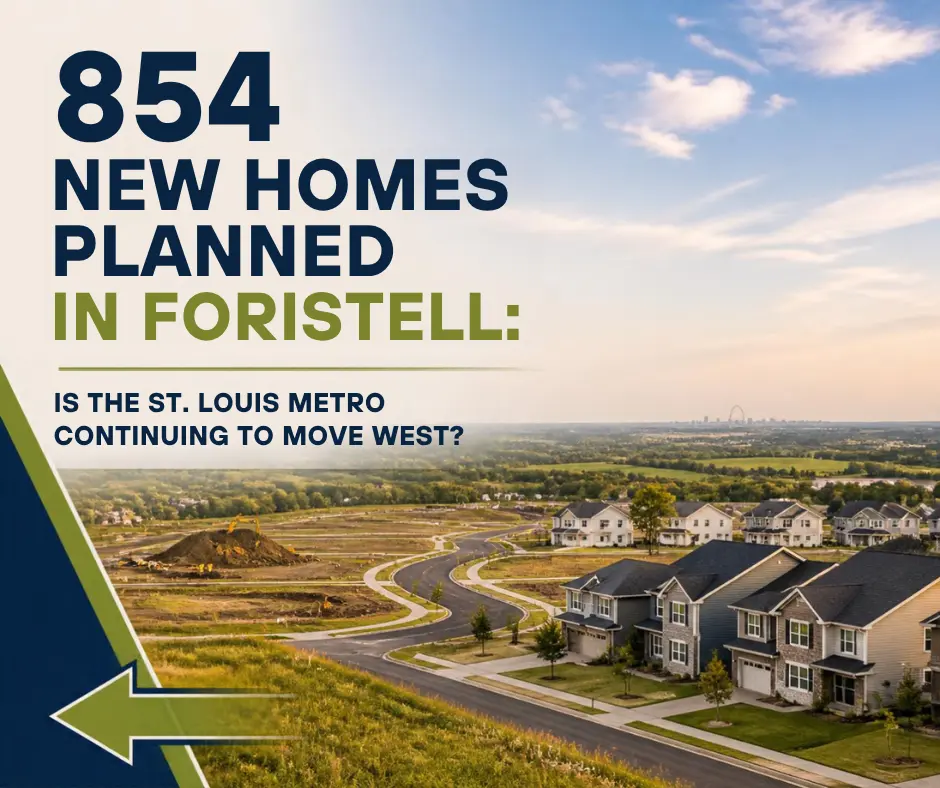
854 New Homes Planned in Foristell: Is the St. Louis Metro Continuing to Move West?
One of the largest new residential developments in the St. Louis region is planned for an area that, not that long ago, many people would have considered well outside the metro.
McBride Homes is planning a massive new residential development in Foristell, Missouri, that could bring approximately 854 new single-family homes to western St. Charles County.
The project, known as Havenwood, is significant on its own.
But the bigger story may be what it tells us about where the St. Louis metro is heading next.
St. Louis continues to expand west.
And communities such as Wentzville, Foristell and even areas approaching Warrenton could become increasingly important parts of the region's housing market.
854 New Homes Is a Major Development
Adding 854 single-family homes isn't simply building another neighborhood.
At that size, you're essentially creating a small community.
Hundreds of new homes eventually mean hundreds of new households.
Those households need grocery stores, restaurants, gas stations, medical offices, childcare, entertainment and other services.
Businesses tend to follow rooftops.
That's one reason large residential developments can have an impact far beyond the boundaries of the subdivision itself.
Why Foristell?
Foristell sits along the I-70 corridor just west of Wentzville.
For years, Wentzville has been one of the areas benefiting from the westward expansion of the St. Louis metropolitan area.
As development continues and available land becomes more difficult or expensive to find closer to the center of the metro, it makes sense that builders would begin looking farther west.
Foristell offers something that's increasingly difficult to find closer to St. Louis:
Large amounts of developable land with relatively convenient interstate access.
That combination can be extremely attractive to large homebuilders.
Look at What Happened to Wentzville
To understand why builders are interested in areas farther west, you only have to look at what happened in Wentzville.
What was once considered a small community on the outskirts of the St. Louis region experienced tremendous residential and commercial growth.
New subdivisions were built.
Retail followed.
Restaurants followed.
Schools expanded.
Major employers and businesses continued investing in the area.
Eventually, what once felt like the edge of the metro became a major suburban housing market.
Could Foristell experience something similar?
Time will tell.
But an 854-home development is certainly a significant vote of confidence in the area's future housing demand.
There's Another Big Piece of This Story: I-70
Housing isn't the only major investment happening along this corridor.
Missouri is also undertaking a massive reconstruction and expansion of Interstate 70 between Wentzville and Warrenton.
The project represents hundreds of millions of dollars in infrastructure investment.
That matters.
Infrastructure and real estate development often go hand in hand.
When transportation improves, previously distant communities can become more practical places to live.
If commute times become more predictable and highway capacity improves, buyers may become more comfortable living farther away from the traditional center of the metro.
That can increase demand for housing.
Housing attracts businesses.
Businesses create jobs.
And the cycle can continue.
Why Are Builders Still Building With Mortgage Rates This High?
This may be the most interesting part.
Mortgage rates remain significantly higher than they were during the ultra-low-rate environment of 2020 and 2021.
Affordability is a major concern for buyers.
Yet builders are still willing to make enormous investments in new housing.
Why?
Because the long-term need for housing hasn't disappeared.
People still get married.
Families still grow.
Renters still become homeowners.
People still relocate.
Older homeowners still downsize.
And people continue moving between different parts of the metro.
Builders aren't necessarily making decisions based on what mortgage rates will be next month.
A development containing hundreds of homes can take years to build out.
They're making a much longer-term bet on where people will want to live.
New Construction Could Become Even More Important to Buyers
There's another reason developments like Havenwood are worth watching.
New-construction builders can sometimes compete for buyers in ways individual homeowners cannot.
When the market slows, builders still have homes they need to sell.
They have construction loans.
They have employees.
They have land.
And they need to continue moving inventory so they can build the next group of homes.
That's why buyers may see builders offering incentives such as:
-
Mortgage-rate buydowns
-
Closing-cost assistance
-
Upgrade packages
-
Appliance packages
-
Lot incentives
-
Price reductions
A resale homeowner may not have the financial structure or motivation to offer the same incentives.
That can make new construction particularly interesting when mortgage rates are elevated.
This Could Create Opportunities for Existing Homeowners Too
Hundreds of new homes entering an area obviously creates competition.
But development can also benefit people who already own property nearby.
As population increases, additional businesses and services often follow.
Vacant commercial land gets developed.
Roads and infrastructure may improve.
Restaurants and retail expand.
More buyers become familiar with the community.
Over time, an area that once seemed "too far out" can become much more mainstream.
We've already watched this happen in other parts of the St. Louis metro.
What Does This Mean for Real Estate Investors?
Investors should be watching these growth corridors as well.
An investor doesn't necessarily need to buy inside the new subdivision to benefit from growth.
Large residential developments can increase demand for surrounding:
-
Rental properties
-
Commercial properties
-
Storage facilities
-
Small multifamily housing
-
Land
-
Retail
-
Service businesses
Sometimes the most interesting investment opportunity isn't the development itself.
It's what's located five or ten minutes away from it.
If hundreds or thousands of new residents are coming to an area, they're going to need places to shop, eat, work and live.
Is Warrenton Next?
That's where this story gets particularly interesting.
Wentzville has already experienced enormous growth.
Now we're seeing major residential investment in Foristell along with significant improvements to I-70 between Wentzville and Warrenton.
So what happens over the next 10 or 20 years?
Does Warrenton increasingly become part of the everyday St. Louis commuter market?
Do more subdivisions begin filling the corridor between Wentzville and Warrenton?
Do additional commercial developments follow?
Nobody knows exactly how quickly that happens.
But major builders and major infrastructure projects are putting a lot of money into the same corridor.
That's something worth paying attention to.
The St. Louis Metro Continues to Change
When people think about St. Louis real estate, it's easy to focus only on today's home prices, inventory and mortgage rates.
But some of the most important real estate trends happen slowly.
A highway gets expanded.
A subdivision gets approved.
Hundreds of houses get built.
Restaurants and stores follow.
Then another subdivision appears five miles farther down the highway.
Eventually, the boundaries of what people consider the "St. Louis suburbs" begin to change.
The proposed 854-home Havenwood development in Foristell could be another step in that process.
At 1st Class Real Estate STL, we'll continue following major residential developments throughout the St. Louis metro and what they could mean for buyers, sellers, homeowners and investors.
Whether you're considering buying new construction, selling a home or investing in one of the region's growing communities, understanding where St. Louis is growing next can be just as important as understanding today's market.
1st Class Real Estate STL
Increasing The Success Rate Of The Real Estate Agent
Categories
Recent Posts