
St. Louis County Homes Need Nearly $3 BILLION in Repairs — What Does This Mean for Our Housing Market?
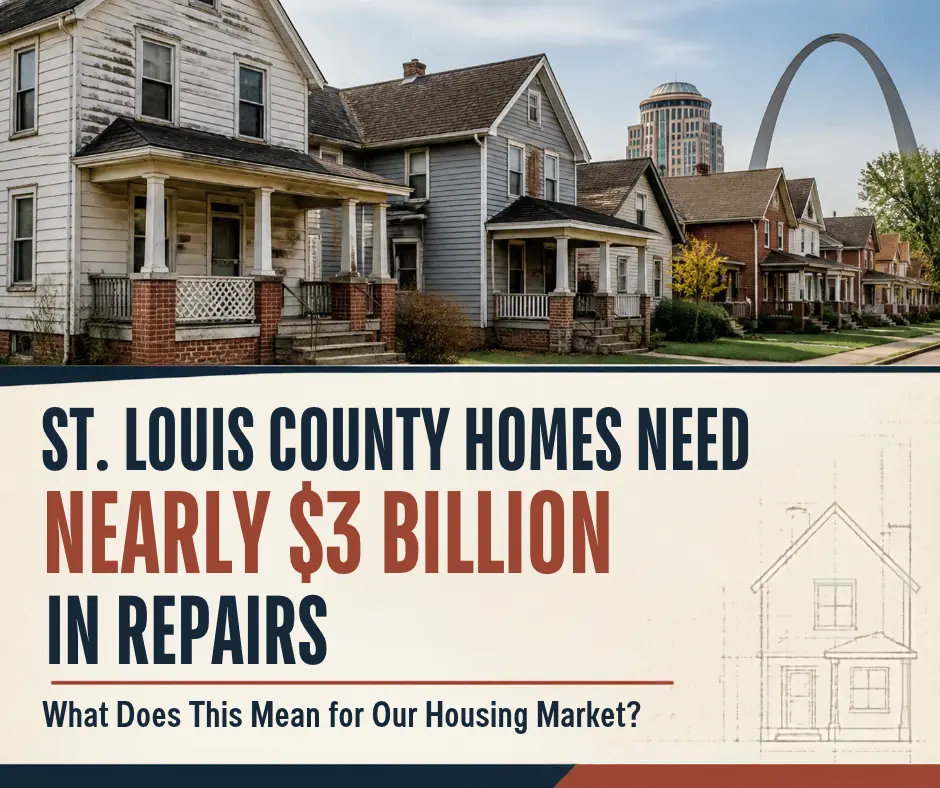
St. Louis County Homes Need Nearly $3 BILLION in Repairs — What Does This Mean for Our Housing Market?
A recent study reveals a massive problem hiding in plain sight throughout St. Louis County. And it could have serious implications for homeowners, buyers, investors, and the future of our neighborhoods.
When we talk about the housing market, most conversations revolve around home prices, mortgage rates, inventory, and whether it's a good time to buy or sell.
But there's another issue that doesn't receive nearly enough attention.
The condition of the homes we already have.
A recent study conducted by researchers at the University of Missouri–St. Louis (UMSL) estimates that single-family homes throughout St. Louis County need approximately $2.92 BILLION in repairs.
Yes, that's billion with a B.
And the findings raise an important question:
Are we so focused on building new homes that we're overlooking the housing inventory we already have?
The Numbers Are Pretty Eye-Opening
According to the study, which surveyed 637 homeowners and estimated repair needs across St. Louis County:
-
$2.92 billion: Estimated total needed home repairs throughout the county.
-
$9,146: Average estimated repairs needed per single-family home.
-
More than $12,000: Average estimated repair needs per home in North St. Louis County.
-
$732 million: Estimated unmet repair needs among low-income households.
And we're not necessarily talking about granite countertops, new flooring, or kitchen remodels.
We're talking about necessary repairs.
Roofing problems.
Water intrusion and basement moisture.
Electrical deficiencies.
Insulation and weatherization.
Aging plumbing and mechanical systems.
These are the types of problems that, when ignored, can become significantly more expensive over time.
And for many homeowners, especially those living on fixed incomes, coming up with $10,000 or more for unexpected repairs simply isn't realistic.
How Did We Get Here?
St. Louis has something that many rapidly growing cities don't.
A tremendous amount of older housing inventory.
Throughout St. Louis County, you'll find neighborhoods filled with homes built in the 1940s, 1950s, 1960s, and 1970s.
Many of these properties have been well maintained and remain excellent homes.
But even a well-built house requires ongoing maintenance.
Roofs eventually need replacement.
HVAC systems wear out.
Plumbing deteriorates.
Electrical systems become outdated.
Foundations and basements develop problems.
And those expenses can add up quickly.
Now combine aging housing with rising labor costs, higher material prices, insurance expenses, property taxes, and everyday living costs.
It's not difficult to understand why some homeowners have been forced to postpone repairs.
The problem?
Deferred maintenance doesn't make the problem disappear. It often makes it worse.
A small roof leak can eventually lead to damaged drywall, insulation, flooring, and structural components.
A minor plumbing issue can become a major water-damage problem.
And a relatively affordable repair today can turn into a much larger expense a few years down the road.
The Bigger Problem: What Happens to Entire Neighborhoods?
Here's where I think this story becomes especially important.
When one homeowner struggles to maintain their property, that's unfortunate.
But when dozens or hundreds of homeowners throughout the same community are struggling with necessary repairs, the consequences can extend beyond individual properties.
Homes begin deteriorating.
Exterior conditions decline.
Potential buyers become more hesitant.
Some homeowners eventually decide to sell rather than make the repairs.
Others may be unable to afford the work required to keep their homes safe and habitable.
In more severe situations, properties can become vacant or abandoned.
And once that happens, the problem becomes much more expensive to solve.
We've already seen what prolonged vacancy and deterioration can do to certain neighborhoods throughout the St. Louis region.
Preserving an existing home before it becomes uninhabitable is often much less expensive than trying to bring it back after years of neglect.
That's why this study matters beyond the homeowners who participated in it.
It's about protecting the long-term health of our neighborhoods.
We're Talking About Housing Affordability — But Are We Missing Something?
Housing affordability has become one of the biggest issues facing Americans.
And St. Louis is certainly no exception.
Higher mortgage rates have made monthly payments more expensive.
Construction costs have increased.
Entry-level housing inventory remains limited in many communities.
And first-time homebuyers are finding it increasingly difficult to purchase their first property.
So naturally, much of the conversation focuses on building more affordable housing.
And we absolutely need additional housing supply.
But here's something worth considering.
What if one of the most effective ways to preserve affordable housing is to keep existing affordable homes from falling into disrepair?
Think about it.
A modest three-bedroom ranch home built in 1965 might provide exactly the type of housing a first-time buyer or young family needs.
But if that property needs $25,000 in repairs, the current homeowner may struggle to maintain it, and a future buyer may struggle to finance the necessary improvements.
If those problems continue getting worse, the property could eventually require a major rehabilitation.
In extreme cases, it could become uninhabitable.
Now we've lost another potentially affordable home.
Building new homes is important.
But so is protecting the housing inventory we already have.
We need to be doing both.
What Does This Mean for St. Louis Homeowners?
If you own a home in St. Louis County, this study should serve as a reminder of the importance of preventative maintenance.
That doesn't mean every homeowner needs to immediately spend thousands of dollars on improvements.
It means understanding which repairs should take priority.
For example:
1. Address water problems immediately.
Roof leaks, basement moisture, plumbing leaks, and drainage problems can cause extensive damage if ignored.
2. Keep up with major mechanical systems.
Regular maintenance of heating, cooling, and plumbing systems can help identify problems before they become emergencies.
3. Don't ignore electrical concerns.
Outdated or damaged electrical components can create safety hazards and should be evaluated by qualified professionals.
4. Prioritize necessary repairs over cosmetic upgrades.
A beautiful new kitchen won't mean much if the roof is leaking or the foundation has serious problems.
5. Explore available assistance programs.
Some homeowners may qualify for financial assistance to address necessary repairs.
St. Louis County has offered home-repair assistance programs, including forgivable loans of up to $7,500 for qualifying homeowners, subject to program rules and available funding.
Homeowners should contact the county to verify current eligibility and availability.
What Does This Mean for Homebuyers?
For buyers, this study highlights something that's becoming increasingly important in today's real estate market.
The purchase price is only one part of the cost of owning a home.
A $225,000 house needing $40,000 in immediate repairs may not be a better deal than a $250,000 house that's been properly maintained.
That's why buyers should carefully evaluate:
-
Roof age and condition
-
HVAC systems
-
Electrical and plumbing
-
Foundation and basement conditions
-
Drainage and water intrusion
-
Windows, insulation, and energy efficiency
-
Major repairs likely to be needed within the next several years
A professional home inspection can help buyers understand potential problems before purchasing.
And with more homes experiencing price reductions throughout the St. Louis market, buyers may have opportunities to negotiate repairs, concessions, or purchase prices.
The key is understanding the actual condition of the property.
Could This Create Opportunities for Real Estate Investors?
Absolutely.
But investors need to understand the risks.
St. Louis has long attracted real estate investors because of its relatively affordable housing prices compared with many other metropolitan areas.
And properties needing repairs can sometimes be purchased below the prices of comparable renovated homes.
However, there's an enormous difference between buying a property at a discount and buying a profitable investment.
Consider this example:
Property A
Purchase price: $100,000
Renovation budget: $40,000
Total acquisition and renovation cost: $140,000, before financing and holding expenses.
Property B
Purchase price: $125,000
Renovation budget: $10,000
Total acquisition and renovation cost: $135,000, before financing and holding expenses.
At first glance, Property A looks like the better deal because the purchase price is $25,000 lower.
But once renovation expenses are considered, Property B may actually be the more attractive investment.
And that's before accounting for unexpected repairs, carrying costs, permits, insurance, and financing.
The cheapest house isn't always the best investment.
For investors considering older properties throughout St. Louis, understanding rehabilitation costs is absolutely essential.
Should Local Governments Invest More in Home Repairs?
This is where the conversation becomes particularly interesting.
St. Louis City and County have invested significant resources into addressing vacant properties, demolition, redevelopment, and affordable housing.
Those efforts are important.
But imagine what could happen if more resources were directed toward helping qualifying homeowners address serious maintenance problems before their properties deteriorated.
A relatively modest repair grant could potentially help prevent a property from becoming unsafe.
That could help a longtime homeowner remain in their home.
It could preserve affordable housing inventory.
And it could reduce the need for much more expensive intervention later.
Of course, these programs require funding, oversight, and accountability.
But the potential benefits deserve serious consideration.
Sometimes the best neighborhood revitalization project isn't building something new.
It's saving something that's already there.
What Does This Mean for the Future of St. Louis Real Estate?
The $2.92 billion estimate should be a wake-up call.
Our region has a tremendous amount of existing housing inventory.
Much of it is located in established neighborhoods with schools, roads, utilities, parks, and other infrastructure already in place.
These homes represent decades of investment by local families.
And they represent potential opportunities for future generations of homeowners.
But that housing inventory needs to be maintained.
If we allow properties to deteriorate faster than we're repairing them, we risk creating additional housing shortages and neighborhood challenges.
That's why the conversation about housing affordability needs to go beyond simply building more homes.
We need to talk about:
Preserving existing homes.
Helping homeowners maintain their properties.
Encouraging responsible investment.
Rehabilitating distressed properties.
And building new housing where it's needed.
All of those strategies have a role to play.
Final Thoughts: Nearly $3 Billion Is More Than Just a Number
When you hear that St. Louis County homes need nearly $3 billion in repairs, it's easy to focus on the size of the number.
But behind that estimate are real homeowners.
Families trying to maintain their properties.
Retirees living on fixed incomes.
First-time buyers looking for affordable homes.
Investors trying to improve distressed properties.
And entire neighborhoods whose futures depend, in part, on the condition of their housing.
The question isn't simply how much it will cost to repair these homes.
It's also what it could cost our communities if we don't.
At 1st Class Real Estate STL, we believe understanding the local housing market means looking beyond sale prices and mortgage rates.
It means understanding the issues affecting our neighborhoods, property values, and the long-term health of our communities.
Whether you're considering buying, selling, or investing in real estate throughout the St. Louis metro, having the right information can make all the difference.
1st Class Real Estate STL
Increasing The Success Rate Of The Real Estate Agent
Source
University of Missouri–St. Louis home-repair needs study, reported by First Alert 4 in October 2026.
The study's countywide repair estimates are projections based on surveyed homeowners, not individual inspections of every property. Repair needs and assistance-program eligibility vary by household and property.
Categories
Recent Posts