How One St. Louis Community Saw Home Values Rise 79% — And What Schools Had to Do With It
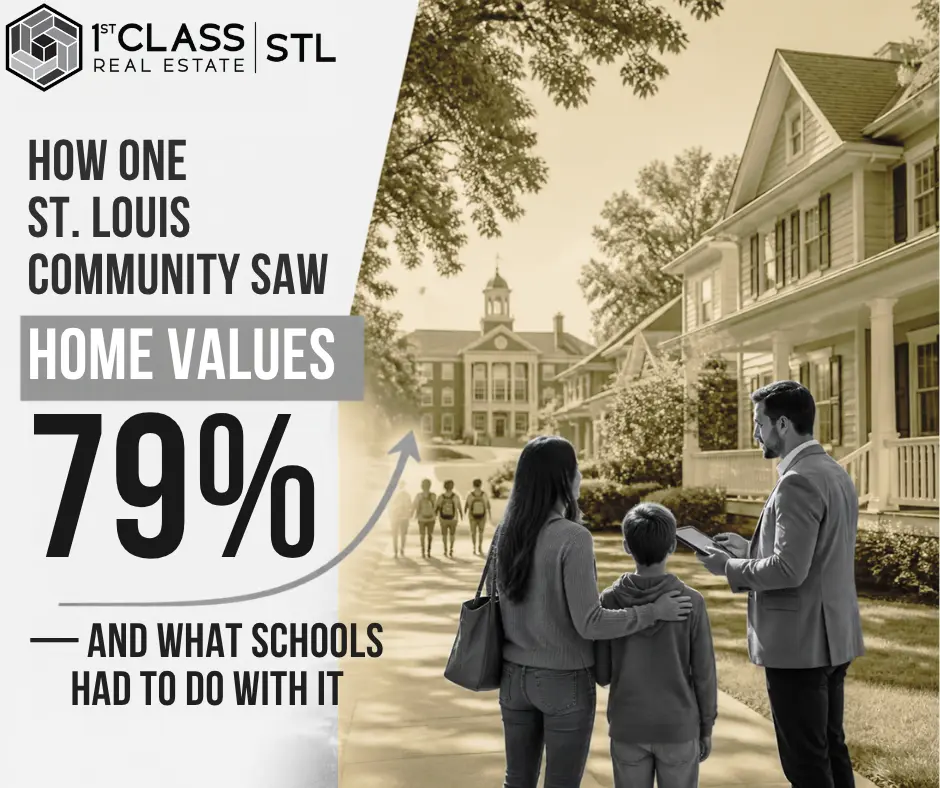
How One St. Louis Community Saw Home Values Rise 79% — And What Schools Had to Do With It
What if one of the biggest factors influencing your home's value wasn't the house itself, but what was happening in the community around it?
That's an interesting question being raised by a remarkable transformation in Maplewood, Missouri.
According to a recent report from the St. Louis Business Journal, home values in Maplewood have increased approximately 79% after adjusting for inflation over the past 26 years.
During that same period, the Maplewood-Richmond Heights School District experienced a dramatic turnaround.
In 2000, the district was reportedly just one point away from losing its accreditation.
Today, the district has reached the highest level of school performance in Missouri.
And while schools aren't the only factor influencing home prices, the story provides an interesting example of how long-term community improvements can coincide with changes in real estate demand.
From Struggling Schools to One of Missouri's Top Performers
To understand the significance of Maplewood's transformation, we need to go back to 2000.
At that time, the Maplewood-Richmond Heights School District was struggling.
According to the St. Louis Business Journal, the district was just one point away from losing its state accreditation.
That's a difficult position for any community.
School performance can influence where families decide to live.
When a district struggles, some buyers may look elsewhere.
But over the following decades, Maplewood-Richmond Heights underwent a remarkable transformation.
By 2025, the district had earned the highest share of possible performance points among Missouri school districts.
That's an extraordinary change from where the district stood just 26 years earlier.
And during that same period, Maplewood's housing market experienced significant long-term appreciation.
Home Values Increased 79% After Inflation
One of the most interesting statistics in the report is that Maplewood home values increased approximately 79% after adjusting for inflation.
That distinction matters.
When someone says home prices increased 79% over 26 years, inflation could account for a substantial portion of the increase.
But an inflation-adjusted increase means the growth exceeded general inflation over that period.
In other words, the reported increase represents growth in real purchasing-power terms.
To illustrate what that means, imagine a property worth $150,000 in inflation-adjusted dollars at the beginning of the period.
A 79% increase would put its equivalent value at approximately $268,500.
That's a significant increase in real value.
Of course, that doesn't mean every individual home in Maplewood appreciated by exactly 79%.
Real estate appreciation varies depending on the property, location, condition, improvements, and other market factors.
But the broader trend is worth examining.
How Much Do Schools Really Affect Property Values?
For many homebuyers, school districts are an important consideration.
Families may evaluate educational programs, academic performance, extracurricular activities, transportation, and proximity to schools when deciding where to purchase a home.
When a district develops a stronger reputation, it can attract additional interest from buyers who prioritize those factors.
And when more buyers are interested in a community, that demand can influence property values.
But there's an important distinction.
The Maplewood story doesn't prove that improving schools alone caused home values to increase 79%.
Real estate markets are influenced by multiple factors.
Maplewood has also benefited from its central location, established neighborhoods, redevelopment, local businesses, and changing buyer preferences.
Still, the relationship between schools and housing demand is something homeowners should understand.
Buyers Don't Just Purchase Houses
One of the biggest mistakes people make when evaluating real estate is focusing entirely on the house.
They look at:
-
Square footage
-
Number of bedrooms
-
Number of bathrooms
-
Kitchen updates
-
Garage space
-
Lot size
Those things certainly matter.
But buyers are also purchasing a location.
And location includes much more than the physical address.
It includes the surrounding community.
The schools.
The businesses.
The parks.
The restaurants.
The transportation options.
The neighborhood's condition.
And the long-term direction of the area.
Two nearly identical houses can have significantly different market values because of their locations.
That's why understanding the neighborhood is just as important as understanding the property.
Maplewood Has Become an Attractive St. Louis Community
Maplewood offers something that many buyers find appealing.
It's centrally located within the St. Louis metro, providing convenient access to major employment centers and surrounding communities.
It also has an established downtown district with restaurants, shops, and local businesses.
Many neighborhoods feature older homes with architectural character.
And the community offers a different living experience from many newer suburban developments.
For buyers who value established neighborhoods, local businesses, and convenient access to the broader metro, Maplewood can offer an attractive combination.
When those characteristics are combined with a school district that has experienced significant improvement, it's easier to understand why buyer interest may grow over time.
What Can Other St. Louis Communities Learn From Maplewood?
This is where the story becomes bigger than one community.
Throughout the St. Louis metro, we have neighborhoods and municipalities at different stages of development.
Some are experiencing rapid new construction.
Others are investing in redevelopment.
Some are improving parks, infrastructure, and public spaces.
Others are working to strengthen schools and attract new businesses.
All of these factors can influence how communities develop over time.
And that can eventually affect real estate demand.
Consider the difference between two neighborhoods.
In one neighborhood, businesses are closing, properties are deteriorating, and public amenities are declining.
In another, businesses are opening, homes are being renovated, parks are improving, and community institutions are getting stronger.
Over time, buyers may begin viewing those communities very differently.
That's why real estate investors and homeowners should pay attention to what's happening beyond their property lines.
What Does This Mean for Homeowners?
If you already own a home, the Maplewood story offers an important reminder.
Your home's value isn't determined exclusively by the improvements you make to the property.
You can remodel your kitchen.
Replace your roof.
Update your bathrooms.
Improve your landscaping.
But you can't control everything happening in your surrounding community.
Local infrastructure, school performance, neighborhood investment, and broader housing demand can all influence property values.
That doesn't mean homeowners should assume every community improvement will automatically increase their home's value.
But it does mean paying attention to local developments can help you better understand your property's long-term market position.
What Does This Mean for Buyers?
For buyers, the lesson is equally important.
Don't evaluate a property based solely on what it looks like today.
Research the community.
Understand local housing trends.
Look at planned developments.
Explore transportation and infrastructure improvements.
Review available school information if that's important to your household.
Consider the neighborhood's amenities and overall housing supply.
And think about whether the location fits your long-term needs.
Buying a home is a major financial decision.
Understanding the surrounding community can help you make a more informed choice.
What About Real Estate Investors?
Investors should also pay attention to the factors that influence long-term neighborhood demand.
A property may look inexpensive compared with other parts of the metro.
But a low purchase price doesn't automatically make something a good investment.
Investors need to consider rental demand, property condition, operating expenses, neighborhood trends, and realistic resale values.
Community improvements can create opportunities.
But investors should be careful about assuming future appreciation is guaranteed.
The strongest investment decisions are based on sound numbers rather than speculation.
The Bigger Lesson: Real Estate Is About More Than the House
The Maplewood-Richmond Heights story is a reminder that communities can change dramatically over time.
In 2000, the school district was reportedly close to losing accreditation.
Twenty-six years later, it has become one of Missouri's highest-performing districts.
During that same period, Maplewood home values increased approximately 79% after adjusting for inflation.
Those two developments don't establish a simple cause-and-effect relationship.
But they do illustrate how a community's long-term transformation can coincide with major changes in its housing market.
And that's something every homeowner, buyer, seller, and investor should understand.
When you're buying real estate, you're not just investing in a house. You're also choosing a community.
At 1st Class Real Estate STL, we believe understanding local neighborhoods, housing trends, and community developments is essential to making informed real estate decisions.
Whether you're buying your first home, considering selling, or looking for your next investment property, our agents can help you understand what's happening throughout the St. Louis metro.
1st Class Real Estate STL
Increasing The Success Rate Of The Real Estate Agent
Categories
Recent Posts